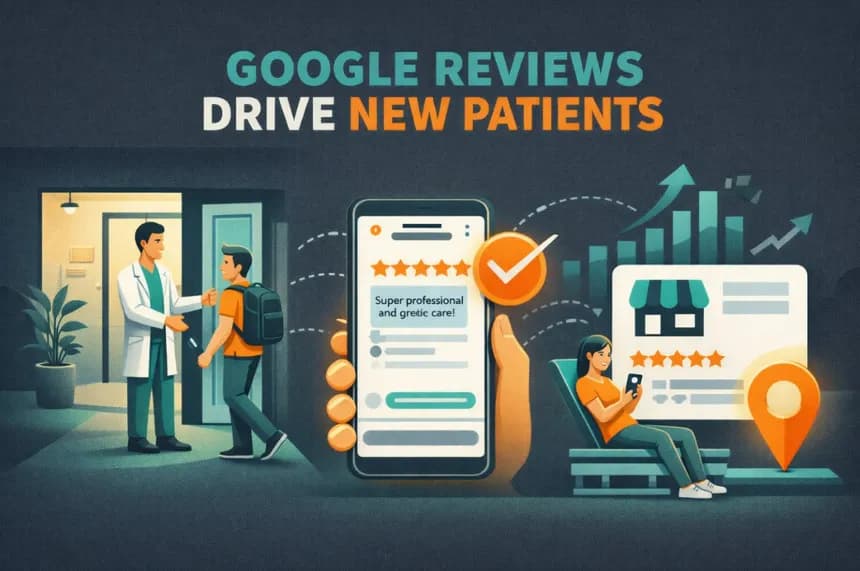

Most clinic owners think of reviews as a reputation tool. Something that helps patients trust you.
That's true. But reviews are also a ranking factor.
Google uses your reviews — their quantity, quality, recency, and your responses — to decide whether your clinic deserves to appear in the top 3 map pack results.
Here's how it works.
How Google Uses Reviews for Ranking
1. Review Quantity
More reviews = more trust signals. A clinic with 200 reviews is seen as more established than one with 20.
But: Quantity alone isn't enough. 200 old reviews won't help if you haven't received a new one in 6 months.
2. Review Recency
Google wants to show currently active clinics. A review from last week is worth more than a review from last year.
The takeaway: You need a steady stream of new reviews. Not a burst, then silence.
3. Review Velocity
How many reviews are you getting per week? A clinic with 5 new reviews every week is more relevant than one with 50 reviews from a single month.
The takeaway: Consistency matters more than spikes.
4. Review Content
Google's AI reads your reviews. If patients mention specific services ("acne treatment," "root canal"), Google associates those keywords with your clinic.
The takeaway: Encourage patients to be specific. "Great doctor" is fine. "Dr. Sharma treated my acne brilliantly" is better.
5. Review Responses
Do you respond to reviews? Google notices. Clinics that engage with reviews are seen as more trustworthy.
The takeaway: Respond to every review. Thank positive ones. Acknowledge negative ones.
The Review Flywheel
Reviews don't just improve your ranking. They create a flywheel:
- More reviews → higher ranking
- Higher ranking → more visibility
- More visibility → more patients
- More patients → more reviews
The flywheel spins faster with every review.
The Clivise Review Engine
The Clivise Review Engine is designed to maximize your local SEO through reviews.
How it works:
- Patient completes appointment. Receptionist taps "Mark Complete."
- 2 hours later, WhatsApp message: "How was your visit? Rate 1–5."
- If 4–5 → Routed to Google review.
- If 1–3 → Routed to private feedback form.
- All reviews appear in your unified dashboard.
The result:
- Consistent review velocity
- Higher Google ranking
- More patients finding you
What to Do with Negative Reviews
Negative reviews are inevitable. How you handle them matters for SEO.
Do:
- Respond within 24 hours
- Acknowledge the issue
- Apologize sincerely
- Take it offline ("Please call us at...")
Don't:
- Argue publicly
- Blame the patient
- Ignore it
- Delete it (you can't)
Google rewards clinics that engage constructively with negative feedback. It shows you're responsive and care about patient experience.
The Competitor Snapshot
The Clivise dashboard includes a competitor snapshot — the top 5 nearby same-specialty clinics and their ratings vs. yours.
Use this to:
- See where you stand
- Identify gaps (are they getting more reviews?)
- Set targets (we need 20 more reviews to overtake them)
The Bottom Line
Reviews aren't just reputation. They're ranking.
Want to appear in the top 3 on Google Maps? Get more reviews. Get them consistently. Respond to them. Let them compound.
That's the local SEO flywheel.
Your Call to Action: Automate your review collection and climb the rankings.